The decentralized finance (DeFi) landscape continues to evolve with innovative protocols, and Momentum (MMT) has rapidly emerged as a standout project within the Sui ecosystem. Since its beta launch in March 2025, Momentum has positioned itself not merely as another decentralized exchange (DEX) but as a comprehensive global financial operating system for the tokenized future. With impressive growth metrics—including over 2.1 million users and $200 billion in total value locked (TVL)—alongside recent listings on major exchanges like Bitget and Binance, Momentum is capturing significant attention in the DeFi space. This article explores MMT's fundamentals, technology, tokenomics, and market potential.
What Is Momentum?
Momentum is a
decentralized finance protocol built on the Sui blockchain to create a unified financial infrastructure for tokenized assets. It functions as a
community-driven ecosystem that combines advanced liquidity strategies with next-generation tokenomics. The project has gained substantial traction, processing
cumulative trading volumes exceeding $27 billion as of November 5, 2025.
Beyond its core DEX functionality, Momentum offers an expanding suite of DeFi solutions, including
automated yield vaults,
liquid staking, and
institutional-grade compliance tools through its Momentum X module. The platform is backed by prominent crypto organizations such as
Coinbase Ventures,
Circle, and
OKX Ventures, providing credibility and resources for continued development.
The Technology Behind MMT
Concentrated Liquidity Market Maker (CLMM)
At the heart of Momentum's architecture is its
Concentrated Liquidity Market Maker model, a significant improvement over traditional automated market makers. Unlike standard DEXs that spread liquidity across the entire price curve, Momentum's CLMM allows
liquidity providers to concentrate their capital within specific price ranges. This design results in
tighter spreads,
deeper liquidity at active trading prices, and significantly
reduced slippage for traders.
ve(3,3) Governance Model
Momentum implements a
ve(3,3) governance model that combines vote-escrowed (ve) token mechanics with game-theoretic incentives. Users can lock their MMT tokens to receive
veMMT, which grants
voting rights over liquidity pool incentives,
protocol fee sharing, and influence over
ecosystem development. This model aligns long-term participant interests with protocol health by rewarding committed stakeholders while discouraging short-term "farm-and-dump" behavior.
Multi-Layer Architecture
The protocol features
sophisticated multi-layer architecture that supports various financial functions, including
decentralized trading,
yield optimization vaults, and
cross-chain interoperability through integration with Wormhole. This infrastructure enables Momentum to function as a comprehensive financial operating system rather than just a trading venue.
Why Momentum MMT Stands Out
Dominant Position in Sui Ecosystem
Momentum has established itself as a
core liquidity hub within the Sui ecosystem, accounting for
24%-43% of Sui's total DeFi volume. Its TVL ranging between
$3.57-6 billion and daily trading volume often exceeding
$1 billiondemonstrates its central role in Sui's DeFi landscape.
Real-World Asset (RWA) Integration
A key differentiator for Momentum is its focus on
real-world asset tokenization, including traditional assets like
stocks,
bonds, and
real estate. This strategic direction positions Momentum at the intersection of traditional and decentralized finance, potentially unlocking trillions of dollars in traditional asset value for the DeFi ecosystem.
Institutional-Grade Infrastructure
Through Momentum X, the protocol offers
institutional-grade tools featuring
on-chain compliance and
identity verification via zero-knowledge proofs. This focus on regulatory compatibility addresses a critical barrier to institutional DeFi adoption.
MMT Tokenomics
Token Distribution
MMT has a
fixed total supply of 1 billion tokens, with an
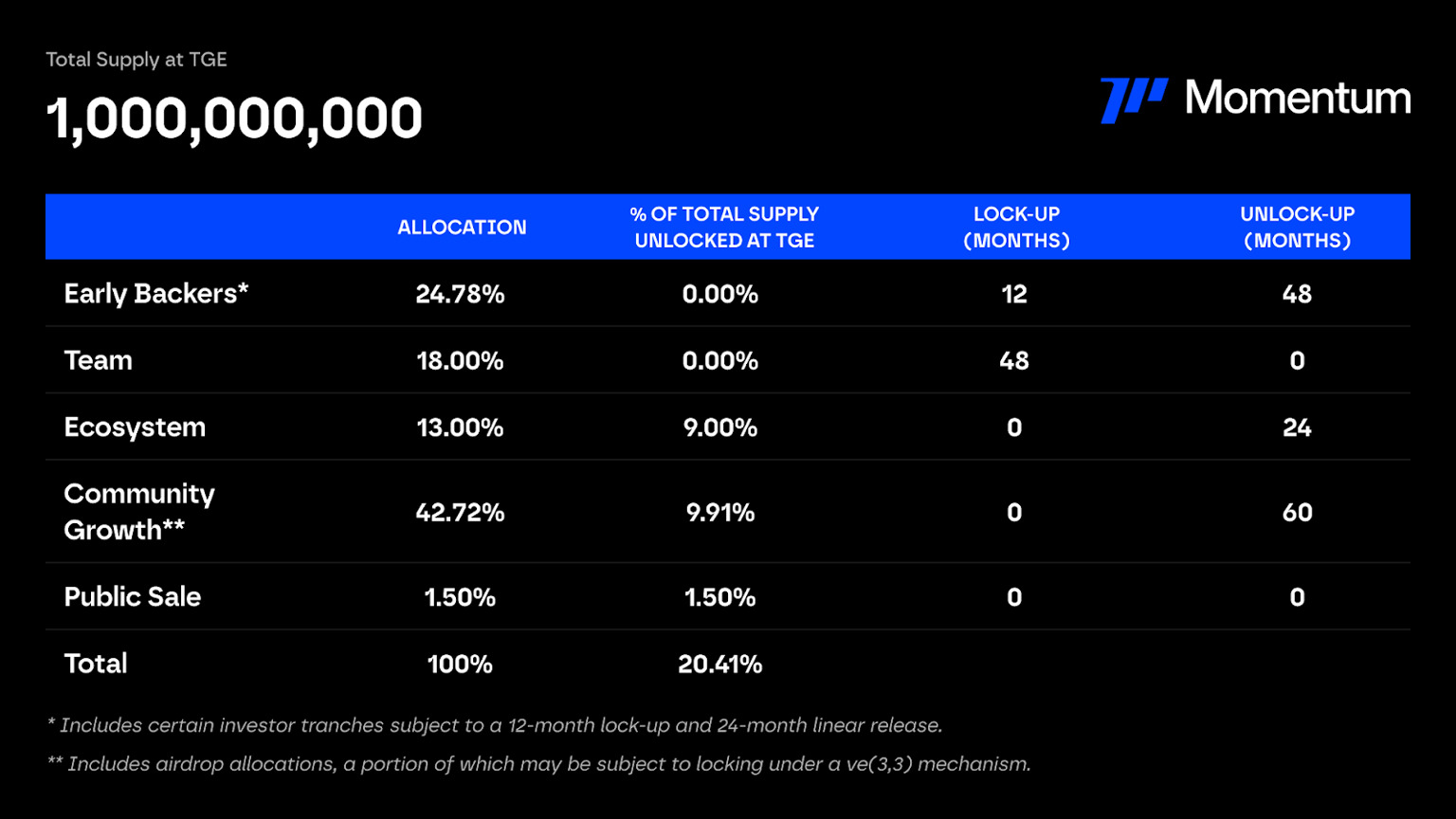
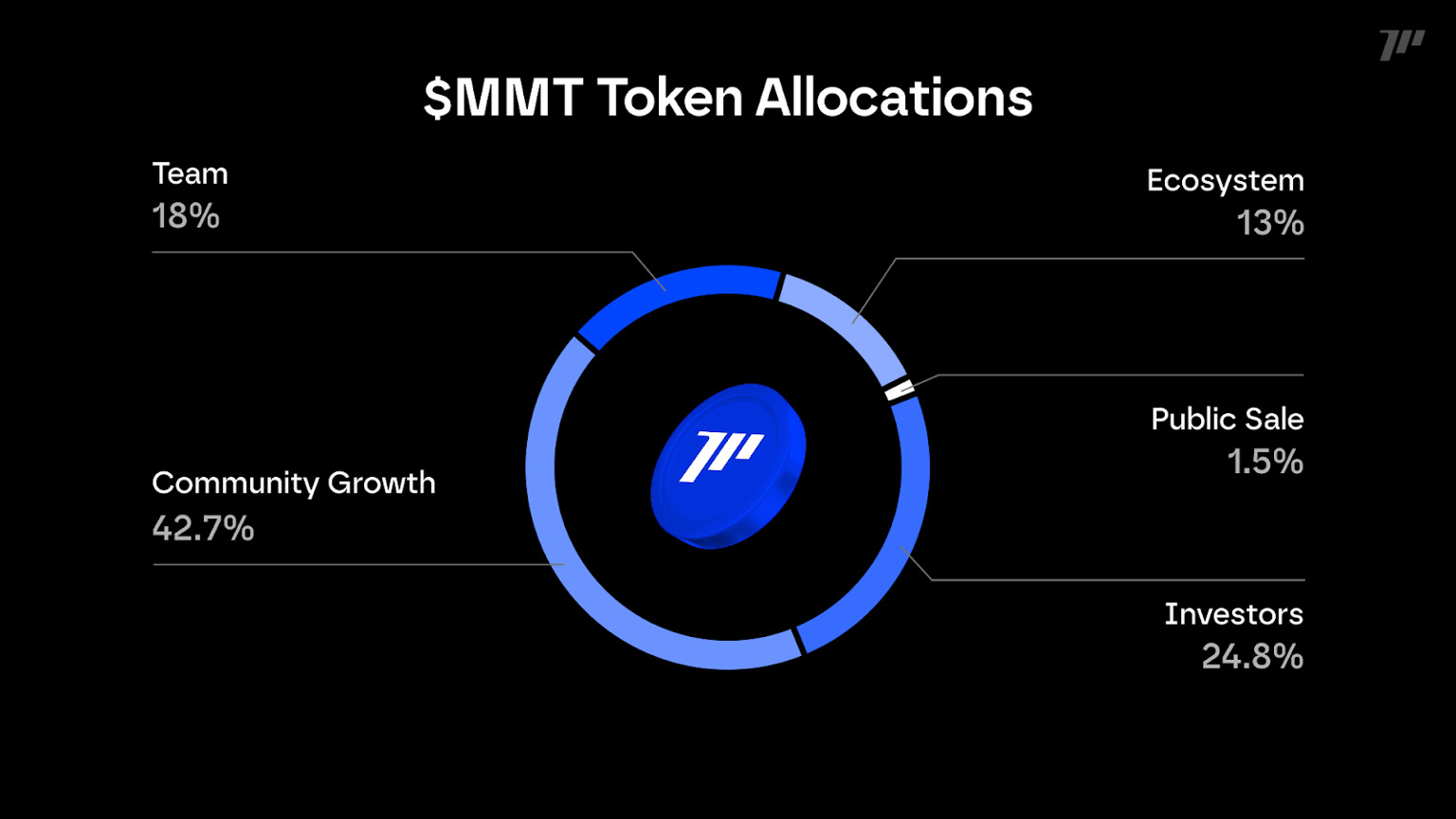
initial circulating supply of approximately 204 million(20.4% of total supply) at its November 2025 listing. The distribution follows a carefully structured model:
-
Community Growth: 42.72% (9.91% unlocked at TGE, remainder over 60 months)
-
Institutional Investors: 24.78% (0% unlocked at TGE, 12-month cliff, then 48-month linear release)
-
Team Allocation: 18% (0% unlocked at TGE, 48-month vesting)
-
Ecosystem Fund: 13% (9% unlocked at TGE, remainder over 24 months)
-
Public Sale: 1.5% (fully unlocked at TGE)
Value Accumulation Mechanics
The MMT token is designed to capture value through multiple revenue streams within the ecosystem.
veMMT holders earn a share of protocol fees generated from trading activities, while also influencing
emission distributions to liquidity pools. The project established a
fully diluted valuation target between $250-350 million during its initial phases, benchmarked against similar ve(3,3) protocols.
Use Cases and Features
Core Utilities
-
Governance: veMMT holders participate in protocol decisions through voting mechanisms
-
Fee Sharing: Locked MMT tokens earn a portion of protocol revenues
-
Liquidity Incentives: MMT distributes rewards to liquidity providers across various pools
-
Platform Access: The token grants exclusive rights to participate in Launchpad sales and special features
Ecosystem Products
-
Momentum DEX: The flagship concentrated liquidity DEX
-
Automated Vaults: Yield-optimizing strategies that automatically compound returns
-
Liquid Staking: Allows users to stake assets while maintaining liquidity
-
Token Generation Lab: Launchpad for new projects within the Sui ecosystem
-
MSafe Integration: Multi-signature security infrastructure for asset management
Investment Potential: Is MMT Worth Buying?
Strengths and Opportunities
Momentum's
established product-market fit within the Sui ecosystem,
robust tokenomics designed for long-term sustainability, and
strategic focus on RWA represent significant growth catalysts. The protocol's
impressive user adoption (over 2.1 million users) and
substantial trading volumes demonstrate real utility beyond speculative interest.
Backing by
reputable investors, including Coinbase Ventures and Circle, provides both credibility and resources for continued development. The project's
multi-chain expansion plans via Wormhole integration could significantly expand its addressable market beyond the Sui ecosystem.
Risks and Challenges
The
initial token unlock structure presents a potential near-term risk, with approximately
20.41% of tokens unlocked in the first month post-TGE. If ecosystem growth fails to keep pace with token releases, this could create selling pressure.
The protocol's
dependence on the Sui ecosystem represents both a strength and a potential vulnerability if Sui fails to maintain its competitive position against other Layer 1 networks. Additionally, the
complex ve(3,3) model requires sustained community participation to function effectively, which could diminish during market downturns.
Recent News and Market Performance
Major Exchange Listings
November 2025 marked significant milestones for MMT, with
listings on both Bitget and Binance on November 4. Bitget launched
perpetual contracts for MMT, while Binance opened
spot trading with MMT/USDT, MMT/USDC, MMT/BNB, and MMT/TRY pairs.
Price Action Analysis
Following its exchange debut, MMT reached an
initial peak of $4.229 before stabilizing around
$1.83 according to data from early November 2025. The token's
market capitalization positioned it within the top 150 cryptocurrencies by market cap, with
24-hour trading volume exceeding $3.3 billion at points, indicating substantial market interest.
Ecosystem Growth Initiatives
Binance allocated
7.5 million MMT tokens for airdrops and marketing campaigns, including
5 million MMT dedicated to post-listing initiatives. The platform also conducted a
HODLer Airdrop from October 17-20, 2025, rewarding users who staked BNB or participated in yield farming.
Conclusion
Momentum MMT represents a sophisticated attempt to build a
comprehensive financial operating system rather than just another DEX. Its
technological foundation, combining CLMM with ve(3,3) governance,
established tractionwithin the Sui ecosystem, and
strategic positioning toward RWA integration creates a compelling value proposition.
While the protocol faces challenges, including
token unlock management and
ecosystem dependence, its
strong institutional backing,
rapid user adoption, and
vision for bridging traditional and decentralized finance suggest significant long-term potential. As with any cryptocurrency investment, prospective MMT holders should conduct thorough due diligence, but Momentum's execution to date positions it as a noteworthy project in the evolving DeFi landscape.
References
CoinCatch Team
Disclaimer:
Digital asset prices carry high market risk and price volatility. You should carefully consider your investment experience, financial situation, investment objectives, and risk tolerance. CoinCatch is not responsible for any losses that may occur. This article should not be considered financial advice.