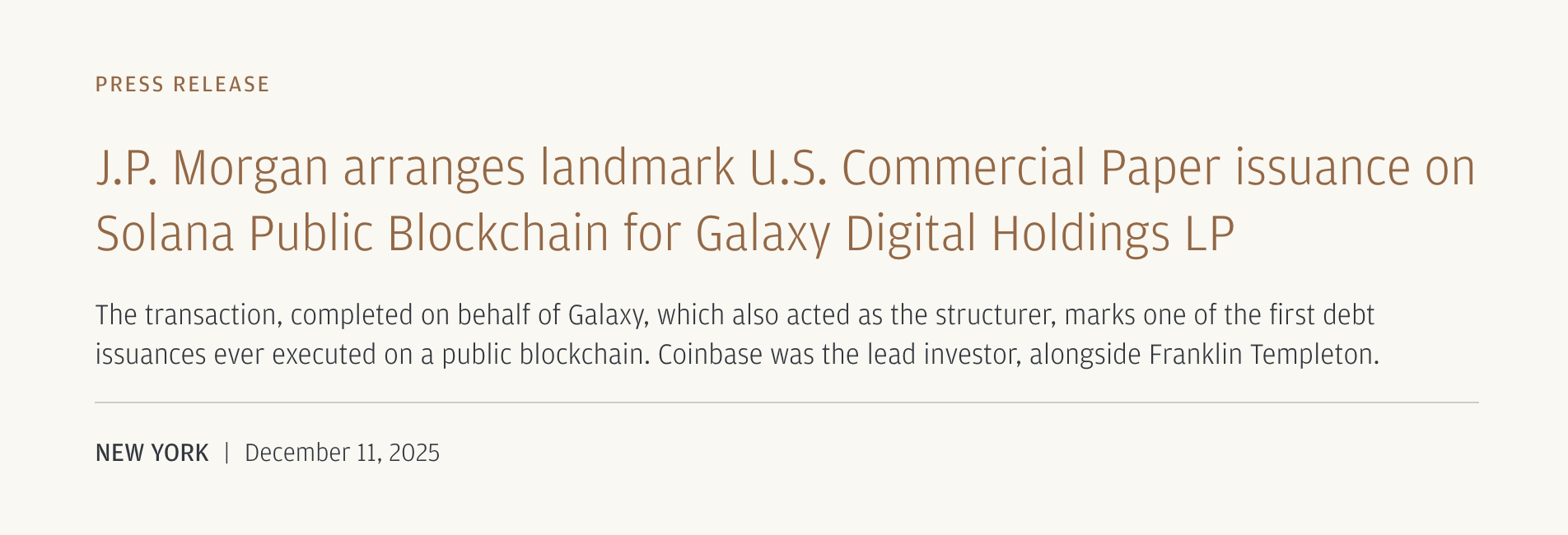
The enduring narrative of cryptocurrency has evolved from one of retail speculation and decentralized ideals to a compelling story of institutional infrastructure. The most convincing evidence of this shift no longer comes from startup labs but from the corner offices of global financial titans. On December 11, 2025, J.P. Morgan, the largest bank in the United States, orchestrated a transaction that may well be remembered as a watershed moment for both traditional finance (
TradFi
) and digital assets. The bank successfully arranged, issued, and settled a U.S. Commercial Paper (USCP) for Galaxy Digital Holdings LP on the Solana public blockchain, with Coinbase and Franklin Templeton acting as investors. This was not an experiment on a private, permissioned ledger but a live, production-grade issuance on an open, public network, settled entirely in the USDC stablecoin.
This event signifies far more than a technical proof-of-concept. It represents a strategic convergence: the immutable, programmable efficiency of public blockchain technology is being deliberately harnessed to refine and upgrade the very pillars of the global capital markets. This analysis delves into the mechanics and significance of J.P. Morgan's landmark transaction. It argues that this move is a definitive signal of the maturing "tokenization of
real-world asset
s" (RWA) narrative, showcasing a pragmatic institutional blueprint for the future, a future where the lines between traditional securities and digital assets blur into obsolescence, giving way to a new, more efficient, and transparent financial architecture.
A Blueprint for On-Chain Finance
To appreciate the breakthrough, one must understand the components of this transaction. Commercial Paper (CP) is a fundamental short-term debt instrument used by corporations to manage daily operational cash flow needs. Its market is vast but has historically operated on legacy systems that can involve multiple intermediaries, manual processes, and settlement delays.
J.P. Morgan's execution re-engineered this process from the ground up using digital asset primitives. The bank acted as the arranger, creating a native on-chain token that digitally represented the commercial paper obligation. This token was then issued to Galaxy Digital, a crypto-native financial services firm, which used it to secure short-term funding. The investors, Coinbase and Franklin Templeton, purchased this tokenized debt instrument. Crucially, every monetary leg of the transaction, the initial payment from investors and the future redemption proceeds at maturity, which was executed in USDC, the dollar-denominated stablecoin issued by Circle.
The choice of partners is itself a statement. Galaxy Digital provided a crypto-savvy issuer, while Franklin Templeton brought the credibility of a major traditional asset manager with its own blockchain initiatives. Coinbase played a dual, pivotal role: not only as an investor committing its balance sheet but also as the provider of critical infrastructure, offering custody, wallet services, and the fiat on- and off-ramps for USDC. This ecosystem approach demonstrates that successful institutional adoption relies on a collaborative network of specialized players.
Why a Public Blockchain and Why Solana?
Perhaps the most analytically significant aspect of this transaction is J.P. Morgan's platform choice. For years, the bank has been a pioneer in blockchain through its permissioned enterprise platform, Onyx. Moving a live securities issuance to a public blockchain like Solana is a profound strategic pivot with clear rationale.
The decision hinges on the unique value propositions of a performant public ledger: unparalleled settlement finality, transparent audit trails, and 24/7 operational availability. Scott Lucas, Head of Markets Digital Assets at J.P. Morgan, stated the transaction demonstrated the bank's "capability to securely bring new instruments on-chain using Solana". Solana's architecture, known for its high throughput and low transaction costs, provides a "predictable execution environment" essential for institutional-scale transactions. This move suggests that for certain financial instruments, the benefits of public network effects, liquidity potential, and interoperability now outweigh the perceived controls of a private, walled-garden system.
Furthermore, the use of USDC for settlement is a masterstroke in practical finance. It eliminates the traditional multi-day settlement lag (T+2), enabling instantaneous delivery-versus-payment (DvP). This reduces counterparty risk, frees up capital, and streamlines the entire lifecycle of the security, from issuance to interest payments to redemption. Jason Urban, Global Head of Trading at Galaxy, framed it as "a clear example of how public blockchains can improve the way capital markets operate".
The Macro Trend of Asset Tokenization
J.P. Morgan's transaction is not an isolated event but a flagship example of the accelerating tokenization megatrend. Tokenization refers to the digital representation of traditional assets—bonds, equities, funds, real estate—as programmable tokens on a blockchain. Proponents argue this process unlocks immense value by enhancing liquidity, enabling fractional ownership, automating compliance, and streamlining back-office operations.
The market potential is staggering. Analysis from Boston Consulting Group (BCG) and Ripple has projected the tokenized asset market could grow to a staggering $18.9 trillion by 2033. Regulatory attitudes are also evolving to support this innovation. As noted in coverage of this trend, U.S. Securities and Exchange Commission (SEC) Chairman Paul Atkins has recently touted tokenization as a key innovation with the potential to reshape the financial system in the coming years.
This transaction by J.P. Morgan is a concrete step into that future. It moves the discourse from theoretical "potential" to a live, replicable model. Sandy Kaul, Head of Innovation at Franklin Templeton, captured this sentiment, noting that "every new institutional deal with onchain issuance, accelerates our collective journey toward a more open, efficient, and resilient financial ecosystem". The tokenization of a simple commercial paper instrument establishes a foundational template that can be scaled to more complex products, creating a parallel, digitized shadow of the entire global securities market.
Traditional Finance's Digital Transformation
The Solana commercial paper issuance must be viewed as a single tactic within J.P. Morgan's broader, multi-year digital asset strategy. The bank has been methodically building the components for this moment. Its earlier work with JPM Coin for wholesale payments and the Onyx platform for repo transactions laid the internal groundwork. This latest move represents an outward-facing expansion, engaging directly with public market infrastructure.
This direction aligns with a broader industry transformation. As observed by financial analysts, "blockchain technology is starting to shift from its status as a crypto-specific concept into a potential component of core banking infrastructure". The technology is being woven into "the tissue that connects payments, deposits and markets," becoming part of "the operating system for modern finance".
J.P. Morgan's ambitions extend beyond debt issuance. Reports from late 2025 indicate the bank plans to soon allow institutional clients to use Bitcoin and Ethereum as collateral for loans, a move that would further integrate digital assets into its core credit operations. When viewed together, these initiatives paint a picture of a financial giant not merely dabbling in crypto but systematically building bridges between the multi-trillion-dollar worlds of traditional and digital finance. The goal is to offer clients a seamless continuum of services, whether they are transacting in tokenized Treasury bonds or pledging digital assets for cash loans.
Implications and Future Trajectory
The implications of this development are profound and multi-layered. For the crypto industry, it provides the ultimate validation. The technology is no longer seeking permission; it is being actively deployed by the most consequential players in global finance. It directs investor attention squarely toward infrastructure projects that enable scalability, security, and regulatory compliance, as well as to the RWA sector itself.
For traditional finance, the pressure to adapt has been ratcheted up significantly. Other major banks and asset managers will likely accelerate their own tokenization roadmaps to avoid being left behind in the race for efficiency and new product offerings. A competitive dynamic for on-chain "firsts" is emerging.
For regulators, the transaction creates a compelling, real-world case study. It demonstrates that public blockchains can be used for compliant, institutional-grade activity under existing frameworks, potentially informing more nuanced and supportive policy.
Looking ahead, the trajectory is clear. Scott Lucas of J.P. Morgan indicated the bank plans to "expand its structure" by adding more investor groups, types of issuance, and security classes. The logical next steps involve scaling the model to larger issuance volumes, incorporating more automated "smart contract" functionalities for interest payments, and expanding into other asset classes like tokenized bonds, funds, and equities. The success of this model could eventually lead to the creation of entirely new, digitally-native financial products that are impossible to construct with legacy technology.
Conclusion
J.P. Morgan's landmark debt issuance on the Solana blockchain is far more than a corporate press release. It is a definitive signal flare marking the arrival of a new phase in financial history. This transaction successfully demonstrates a viable, end-to-end model for bringing foundational capital market instruments onto public digital infrastructure. It proves that the efficiency, transparency, and programmability of blockchain are not antithetical to institutional needs but can be harnessed to meet them in superior ways.
The move is a powerful accelerant for the asset tokenization revolution, providing a clear blueprint for the industry. It underscores a broader, irreversible trend: the digital transformation of traditional finance is now inextricably linked with the institutional adoption of crypto-native technologies. The walls between the two worlds are crumbling, not through disruption from the outside, but through deliberate, strategic integration from within the very heart of the establishment. The future of finance is being built on-chain, and with this transaction, J.P. Morgan has laid a cornerstone.
Reference:
J.P Morgan. (2025, December 11). JPMorgan commercial paper issuance Solana blockchain. https://www.jpmorgan.com/about-us/corporate-news/2025/jpmorgan-commercial-paper-issuance-solana-blockchain
CoinCatch Team
Disclaimer:
Digital asset prices carry high market risk and price volatility. You should carefully consider your investment experience, financial situation, investment objectives, and risk tolerance. CoinCatch is not responsible for any losses that may occur. This article should not be considered financial advice.